0:00
Why Terrestrial AI Infrastructure is Hitting Hard Limits
OK, so let's unpack this, because when you look at the sheer scale of the infrastructure being built right now, it will it completely shatters any normal sense of reality.
0:10
Speaker 2
It absolutely breaks your brain if you try to think about it in normal human terms.
0:13
Speaker 1
Right, because usually when we talk about a new building project or a data center, there's an expectation of human scale.
You know a skyscraper is massive, but you can stand at the bottom, crane your neck, and intuitively comprehend the physics of it.
0:29
Speaker 2
You can wrap your head around a tall building, yeah.
0:30
Speaker 1
Exactly.
But the physical footprint of modern artificial intelligence, that human scale is just gone.
Like, consider Meta's Hyperion data center compound in Louisiana.
0:42
Speaker 2
Yeah, that's a perfect.
0:43
Speaker 1
Example it takes up 2250 acres.
I mean for you listening just imagine Central Park in New York.
Now multiply that by 2.7.
That is one single AI facility.
0:53
Speaker 2
And honestly, the acreage is sprawling, sure, but the power draw is what truly breaks grid physics.
I mean, that single facility is designed to consume 5 gigawatts of power.
1:04
Speaker 1
5 gigawatts.
If you look at the grid models, turning on that one facility instantly increases the entire state of Louisiana's energy demand by 30%.
1:13
Speaker 2
Just boom, overnight.
1:14
Speaker 1
Right.
And that's the bottleneck, right?
You can't just flip a switch for five gigawatts.
I mean, transmission lines would literally melt.
1:20
Speaker 2
Oh totally good, you need custom substations and those take what, 4 years to build?
1:25
Speaker 1
At least, and this isn't isolated, looking at the data center density in Texas, they have over 400 giga scale campuses either built or planned.
1:34
Speaker 2
Which is demanding nearly 58 gigawatts of off grid power.
1:38
Speaker 1
It's insane.
We're essentially watching the tech industry try to build private parallel power empires because the municipal grids are just tapped out.
1:47
Speaker 2
They're completely tapped out.
The fiscal limitations of our planet are now basically the primary ceiling for artificial intelligence, which is.
1:54
Speaker 1
Wild to think about.
1:56
Speaker 2
It is, I mean global AI high power demand is aggressively tracking to hit 945 terawatt hours by 20-30.
2:03
Speaker 1
Wait 945.
2:05
Speaker 2
Yeah, Terawatt hours.
We are running out of contiguous land, We are running out of freshwater to cool the server racks, and we are fundamentally running out of baseline power generation.
Earth itself is well, it's full.
2:19
Breaking Constraints with Limitless Orbital Solar Power
Which perfectly sets up the core mission of our deep dive today.
Because if the terrestrial grid is buckling under the weight of AI inference, the trillion dollar companies driving this technology are only looking in One Direction to solve the physics problem.
2:35
Up up exactly.
Today we are exploring the trillion dollar orbital AI race.
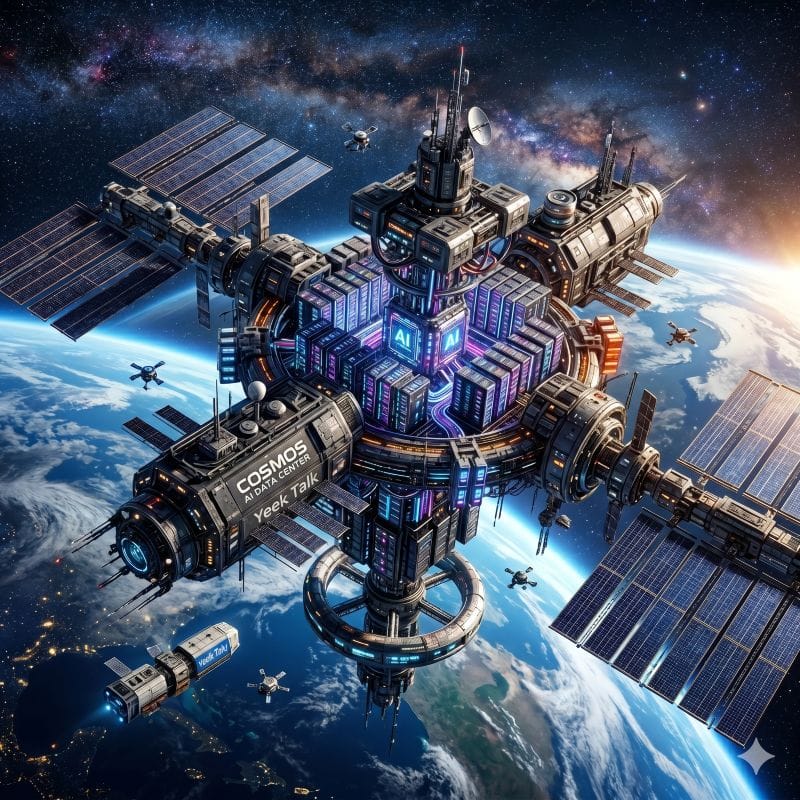
The world's biggest tech Titans and superpowers are actively racing to put data centers in orbit.
2:46
Speaker 2
Which sounds like science fiction, but it's happening.
2:48
Speaker 1
It really does.
But the thesis is that space offers limitless solar power and free cooling, effectively breaking Earth's physical constraints.
2:56
Speaker 2
Right.
And it forces a total paradigm shift and how we view the orbital domain.
You know, for decades space has been utilized for observation or communication, human exploration.
Now lights.
3:06
Speaker 1
Taking pictures, the ISS, that sort of thing.
3:09
Speaker 2
Exactly.
But this transition treats low Earth orbit as an industrial park, and the primary engine for that industrialization is unmitigated access to the Sun.
3:19
Speaker 1
Because the sun emits what, 100 trillion times humanity's total terrestrial electricity production?
3:25
Speaker 2
Yeah, the scale of raw energy up there is incomprehensible.
3:29
Speaker 1
And catching that energy down here on Earth is incredibly inefficient.
I mean, a terrestrial solar panel has to deal with atmospheric scattering, weather systems, and, well, the simple rotation of the Earth.
3:40
Speaker 2
Right.
It's essentially offline for 12 hours a day.
3:43
Speaker 1
Exactly.
But if you place an an array in the right orbital trajectory, you bypass the atmosphere entirely.
The productivity multipliers are just wild and send an orbital panel can be up to 8 times more productive than its terrestrial counterpart.
3:57
Speaker 2
You achieve near continuous solar harvesting and from a systems engineering standpoint that's huge.
Eliminating the night cycle removes the necessity for massive lithium heavy battery banks.
4:08
Speaker 1
Because you don't have to store power to survive the dark.
4:11
Solving the Challenge of Cooling AI in Space
Exactly.
You just continuously route the harvested direct current straight into the computational payload.
4:17
Speaker 1
OK, but I have to push back on the thermal mechanics here, because this is the fundamental paradox of putting blazing hot microchips in space, ah.
4:25
Speaker 2
Yes, the heat issue.
4:27
Speaker 1
Right, because these new AIGPUS, they run incredibly hot now space is famously cold, roughly -270°C.
4:36
Speaker 2
Freezing.
4:37
Speaker 1
Freezing, but it is also a vacuum, and you know a thermos is specifically a vacuum designed to trap heat because there are no air molecules to carry the thermal energy away, right?
So if Orbit is basically a giant thermos, how are they planning to cool millions of thousand Watt GPU's without any air to run over the heat sinks?
4:56
Speaker 2
That is the defining engineering bottleneck of this entire endeavor.
The aerospace sector literally calls it the thermos paradox.
5:04
Speaker 1
The thermos paradox.
I love that name.
5:06
Speaker 2
It's very fitting because in a terrestrial data center, thermal management relies heavily on convection.
You use massive industrial fans to force chilled air over the server blades.
5:16
Speaker 1
Or you pump cold water through micro channels in the chip itself.
5:19
Speaker 2
Exactly.
The heat transfers to the fluid medium, the air or the water, and is physically carried out of the building.
5:25
Speaker 1
So the air acts as the transit vehicle for the thermal energy, yes.
5:30
Speaker 2
But in a vacuum, you have no transit vehicle.
5:33
Speaker 1
Right, there's no air to blow the heat away.
5:35
Speaker 2
Precisely without convective fluids, a spacecraft must rely entirely on radiative cooling.
5:41
Speaker 1
Meaning what exactly?
5:42
Speaker 2
Meaning the heat generated by the GPU has to be captured, moved via internal two phase fluid loops to the outer hull of the satellite, and then physically emitted into the blackness of deep space as infrared radiation.
5:55
Speaker 1
Wow, so the architecture of the satellite is completely dictated by its thermodynamics 1.
5:59
Speaker 2
100% you aren't just launching a box of servers.
6:01
Speaker 1
You need massive specialized radiator panels physically unfolding from the chassis just to dump the heat.
6:08
Speaker 2
And radiative cooling scales with surface area.
To cool a GW of compute, you need an astonishing amount of radiator square footage.
6:16
Speaker 1
So the satellite just becomes this balancing act between giant solar arrays catching the photons and giant radiator panels emitting the infrared heat.
6:24
Speaker 2
Exactly.
But the companies driving this architecture understand that thermal penalty, and they view it as a necessary tax.
6:30
Speaker 1
A tax on limitless energy.
6:32
Elon Musk's Plan for a Million Orbital AI Satellites
Right, because they aren't treating this as just a new product line.
They view off planet computation as the prerequisite for a Kardashev Type 2 civilization A.
6:44
Speaker 1
Kardashev type 2.
It really does read like a blueprint for a Dyson sphere precursor.
It really does.
We are literally talking about surrounding our planet with an artificial shell of raw computational infrastructure just to feed large language models.
It's.
6:58
Speaker 2
Wild but.
6:59
Speaker 1
Looking at the sheer scale of the hardware involved, giant radiators, giant solar panels, heavy compute chassis, Who actually possesses the vertical integration to build, launch and operate this?
7:11
Speaker 2
Well, that brings us to the $1.25 trillion merger between SpaceX and Elon Musk's XAI.
7:18
Speaker 1
Right.
That merger is just massive.
7:21
Speaker 2
The financial structuring of it is a clear indicator of the capital intensity required for orbital compute.
By combining the world's most dominant launch provider with a top tier AI lab, specifically the Grok platform, they created a single entity valued at over a trillion dollars.
7:35
Speaker 1
And they're aiming for an IPO that could pull in 40 to $80 billion in liquid capital.
7:41
Speaker 2
Yeah, and they need every cent of that liquidity because their FCC application for an orbital data center system is almost incomprehensible in its scale.
7:50
Speaker 1
Yeah, let's talk about that application, because they aren't proposing a few specialized satellites.
No, not at all.
They're explicitly asking for spectrum allocation to support a constellation of up to 1,000,000 satellites.
8:03
Speaker 2
A million, I mean to contextualize a million satellites.
There are currently only a few thousand Starlink units in orbit.
8:09
Speaker 1
And that already represents a vast majority of active human infrastructure in space.
8:13
Speaker 2
Right, so multiplying that footprint requires an entirely new approach to mass manufacturing and orbital insertion.
8:19
Speaker 1
And these wouldn't be simple Internet relays like the current Starlinks.
8:24
Speaker 2
No, these are heavy compute nodes.
They would communicate via Cobb and frequencies and optical space lasers.
8:29
Speaker 1
Forming this synchronized mesh network of raw compute.
But the math of actually getting a million units up there, that hinges entirely on Starship, right?
8:37
Speaker 2
It has to Starship changes the entire economic calculus of payload mass.
It is designed to lift 200 tons to low Earth orbit per flight.
8:46
Speaker 1
200 tons.
8:47
Speaker 2
With a completely reusable architecture and the launch cadence they are modeling is aggressive, potentially a launch every hour.
8:56
Speaker 1
Wait, just pause on the logistics of that for a second.
A 200 ton skyscraper launching every hour?
Yeah, that requires an assembly line for satellites that rivals global automotive manufacturing.
9:08
Speaker 2
Scarth.
9:08
Speaker 1
Passes it the noise pollution, the propellant reduction.
It's an industrial mobilization on a scale we haven't seen since the Second World War.
9:15
Speaker 2
It really is, and the internal mathematics provided by SpaceX suggests that if they achieve a launch rate of 1,000,000 tons of payload per year and they can squeeze 100 kilowatts of computational power out of every ton of hardware.
9:30
Speaker 1
Then they inject 100 gigawatts of AI compute into their orbital network annually.
9:34
Speaker 2
Exactly.
9:35
Speaker 1
But there's a nuance in the XAI integration that I found fascinating.
They aren't just putting servers in space to answer, you know, ChatGPT prompts for people down here on Earth.
9:45
Speaker 2
No, the latency would be terrible for that anyway.
9:47
Speaker 1
Right.
The integration of the Grok platform, specifically they're calling Grok Light, is driven by the unyielding physics of the speed of light.
9:55
Speaker 2
This is the critical pivot toward edge computing, because if the long term vision is an interplanetary infrastructure expanding toward the Moon and Mars, latency becomes an insurmountable barrier for centralized compute.
10:08
Speaker 1
Because a radio signal traveling from Earth to Mars takes roughly 22 minutes one way.
10:13
Speaker 2
Exactly.
So a 44 minute round trip for a simple ping.
10:16
Speaker 1
Right.
So if a Martian habitat or an orbital relay experiences a critical failure, say a micrometeoroid punctures a coolant line, you can't send a telemetry packet to a server in Texas.
10:27
Speaker 2
No, you'd be waiting for an AI to analyze the drop in pressure and then waiting another 22 minutes for the valve closure command to arrive.
10:35
Speaker 1
The hardware would be destroyed long before the signal ever returned.
10:39
Speaker 2
Precisely.
Interplanetary infrastructure necessitates localized autonomous reasoning.
The system must diagnose anomalies, reroute network traffic, and execute survival protocols instantly.
10:50
Speaker 1
Without terrestrial oversight.
10:52
Speaker 2
Right, and that is the function of Groklite.
It is a highly quantized, heavily compressed version of their primary large language model.
11:00
Speaker 1
Optimized to run on the physical edge, meaning the local silicon of the spacecraft itself.
11:05
Speaker 2
Exactly.
The AI acts as the onboard flight engineer, continuously inferencing telemetry data directly on the satellite.
11:12
Google and Amazon's Aggressive Orbital AI Projects
It's brilliant.
But you know, while SpaceX has the vertical integration with the Rockets, the terrestrial cloud computing market is currently an oligopoly run by Big tech.
Google.
Amazon, Microsoft.
11:23
Speaker 2
Oh yeah, and they aren't about to just hand over the future of compute.
11:26
Speaker 1
Right, they are not seeding the orbital cloud to a single launch provider.
Which brings us to Google's countermove project, Suncatcher.
11:33
Speaker 2
Google's timeline for Suncatcher is highly accelerated.
They're partnering with Planet Labs and targeting early 2027 to deploy their first prototype satellites.
11:42
Speaker 1
2027 is right around the corner.
11:44
Speaker 2
It is their objective is to validate the transition of their proprietary silicon into the orbital environment.
11:50
Speaker 1
Which brings up the second massive hurl after the thermos paradox radiation.
11:55
Speaker 2
Ah yes, the shooting gallery.
11:57
Speaker 1
Right, because the Earth's magnetic field acts as a planetary shield for our terrestrial data centers.
But once you cross into low Earth orbit, you are flying through a storm of high energy cosmic rays and solar protons.
12:09
Speaker 2
And microchips really do not like high energy protons.
12:12
Speaker 1
No.
If a high energy particle slams into a nanometer scale transistor, it flips a bit, corrupts the data, or just outright destroys the silicon lattice.
12:22
Speaker 2
And standard procedure in aerospace is to use heavy shielding or specially manufactured sapphire substrates.
12:28
Speaker 1
Which completely ruins the economics of the chip, right?
12:31
Speaker 2
Totally.
A radiation hardened processor is usually years behind commercial tech and costs a fortune, but that vulnerability is exactly what Google tested.
12:40
Speaker 1
They bypassed theoretical modeling and just subjected their custom silicon, the Trillium generation cloud tensor processing units, to physical bombardment.
12:49
Speaker 2
Yeah, they put the TP us in a particle accelerator and struck them with a 67 mega electron Volt proton beam.
12:56
Speaker 1
Which sounds like a sci-fi weapon.
12:58
Speaker 2
It basically is.
They did it to simulate the raw radiation environment of space.
13:02
Speaker 1
And the data shows they survived up to 15 killer ads of silicon radiation dose.
Now a killer ad is a measure of absorbed radiation energy.
But I was shocked by the baseline here the.
13:12
Speaker 2
Baseline is what makes it so impressive.
13:14
Speaker 1
Right, because 15 killer ads is 3 times the cumulative dose a satellite is expected to absorb over a five year mission in that orbit.
13:21
Speaker 2
And they suffered no hard failures.
None.
The survival of the TP US challenges decades of aerospace dogma.
It suggests that modern, highly dense, incredibly complex microchip are to some extent radiation hardened by default.
13:37
Speaker 1
Just simply due to their dense node architecture and aggressive error correcting code.
13:41
Speaker 2
Exactly.
And if you don't need custom fabricated, incredibly expensive radiation hardened chips.
13:46
Speaker 1
The capital expenditure to build a space server drops dramatically.
13:50
Speaker 2
It plummets.
13:51
Speaker 1
Right, but a single surviving chip doesn't equal a data center and AI clusters.
Power comes from thousands of chips acting as a single brain.
13:59
Speaker 2
The interconnect issue.
14:00
Speaker 1
Exactly.
On Earth, Google connects their server with massive trunks of fiber optic cables moving 10s of terabytes of data every second.
14:08
Speaker 2
And you obviously can't spool a physical fiber cable between two satellites moving at hypersonic speeds.
14:14
Speaker 1
No, that would be a mess.
So this is the bandwidth challenge.
To replicate the interconnect speeds of a terrestrial data center, Google is forced to utilize free space optical inter satellite links.
14:26
Speaker 2
Highly focused space lasers.
14:28
Speaker 1
Space lasers.
But the physics of optical transmission dictates that the bandwidth decays rapidly as the distance between the transceivers increases.
14:36
Speaker 2
Because of beam divergent and tracking micro jitter.
14:39
Speaker 1
Right.
So to maintain those terabit speeds, the satellites have to fly incredibly close to each other.
14:44
Speaker 2
And the modeling shows Google targeting an 81 satellite cluster where the individual units maintain a distance of only 100 to 200 meters.
14:51
Speaker 1
100 meters maintaining 100 meter separation while orbiting the Earth at 17,000 mph.
14:57
Speaker 2
It requires phenomenal autonomous navigation.
15:01
Speaker 1
It's a terrifying orbital ballet.
I mean at those distances any slight gravitational anomaly, a micro fluctuation in solar wind drag, or a tiny variance in the Earth's sublateness means they drift.
15:13
Speaker 2
They must be constantly firing micro thrusters just to prevent a catastrophic collision.
15:17
Speaker 1
The station keeping the fuel budget alone must be a massive engineering constraint.
15:22
Speaker 2
Oh, it's huge.
But Google's internal economic modeling suggests the payoff justifies the risk.
15:29
Speaker 1
Because they calculated a specific economic tipping point.
15:32
Speaker 2
Right.
Yeah, If the cost to launch a kilogram of payload falls below $200 by the mid twenty 30s, the amortized cost of a space based compute cluster achieves parity with the skyrocketing energy and cooling cost of terrestrial data centers.
15:47
Speaker 1
$200 a kilogram is the magic number.
15:49
Speaker 2
That's the target.
15:50
Speaker 1
And Google isn't the only tech giant running that math.
Amazon, leveraging Jeff Bezos's Blue Origin, is moving aggressively with Project Sunrise.
15:59
Speaker 2
Filing for a 50,000 satellite network utilizing their Terra Weave communications backbone.
16:05
Speaker 1
50,000.
16:05
Speaker 2
It's massive, and Project Sunrise aligns perfectly with Jeff Bezos's foundational philosophy regarding planetary utilization.
16:12
Speaker 1
Right.
He has argued for years that Earth is fundamentally A delicate, finite ecosystem.
16:18
Speaker 2
And that it should be strictly zoned for residential and light industrial use.
16:23
Speaker 1
Like urban zoning, you don't permit a heavy steel mill to operate next to a residential neighborhood.
16:28
Speaker 2
Exactly, and GW scale AI inference facilities are the ultimate heavy resource intensive industry.
16:34
Speaker 1
So Bezos's stance is that to preserve the terrestrial biosphere, all power hungry high heat computation must be offshored to the orbital domain.
16:44
Speaker 2
Where space and solar radiance are virtually infinite.
16:48
Speaker 1
It's a really elegant vision.
So we have this intense domestic competition, Musk, Bezos and Google all trying to establish dominance in the orbital cloud.
16:57
Speaker 2
The Billionaire Space Race Part 2, right?
17:00
Speaker 1
But while the American private sector battles it out, there is an entirely different kind of competitor moving into this space.
Yes, and they aren't constrained by quarterly earnings reports or venture capital timelines.
They are moving with the synchronized weight of a nation state.
17:14
The Geopolitical Race for Sovereign Orbital AI Compute
We have to talk about China's sovereign space cloud.
17:16
Speaker 1
Yes, let's dig into that because the geopolitical vector of this race is advancing at an incredible velocity.
17:23
Speaker 2
It is a highly coordinated state back deployment strategy and the tip of the spear is a commercial entity called Beijing Orbital Twilight Technology.
17:33
Speaker 1
Operating under the name Orbital Chengwang, right?
And when we look at aerospace startups within the Chinese economic model, we aren't talking about lean teams scraping together seed funding in a garage.
17:45
Speaker 2
No Orbital Chengwang recently secured strategic credit lines totalling CN¥57.7 billion.
17:52
Speaker 1
Which is roughly 8 point .4 billion U.S. dollars backed by 12 major state banks, including the Bank of China.
18:00
Speaker 2
An $8.4 billion credit facility signals a massive, massive prioritization by the central government.
18:06
Speaker 1
Absolutely, and their technical architecture is highly specific and distinctly different from the mega constellations proposed by SpaceX.
18:13
Speaker 2
Very different.
They are targeting a sun synchronous dawn, dusk orbit.
18:17
Speaker 1
Positioned approximately 700 to 800 kilometers above the Earth.
18:21
Speaker 2
And the physics of a dawn, dusk orbit are just brilliant.
18:24
Speaker 1
Because they are positioning the satellite to ride the Terminator line.
For you listening, that's the physical dividing line between day and night on the Earth's surface, right?
18:33
Speaker 2
Twilight.
It requires a very specific orbital inclination to ensure the satellite's procession exactly matches the Earth's orbit around the Sun.
18:42
Speaker 1
So when executed correctly, the satellite is essentially surfs the edge of the Earth's shadow without ever fully entering it.
18:48
Speaker 2
It is bathed in near constant sunlight, achieving continuous solar harvesting 24 hours a day.
18:54
Speaker 1
Maximizing the solar intake to hit their stated goal of A1 GW space data center by 2035.
18:59
Speaker 2
And this is deeply integrated into the state owned space contractor CAC with precursors like their three body edge computing constellation already validating the orbital hardware.
19:09
Speaker 1
Which forces a fascinating strategic comparison if we analyze the US China rivalry in this specific sector, it's a profound contrast in asymmetric advantages it.
19:19
Speaker 2
Really is the United States maintains A decisive, undisputed lead in semiconductor architecture.
19:25
Speaker 1
Right, the computational density of Nvidia's upcoming chips is just unparalleled.
19:29
Speaker 2
But those cutting edge chips are explicitly banned from export to China under current trade controls.
19:35
Speaker 1
So Chinese aerospace engineers are forced to design their orbital clusters around older, legally permitted silicon.
19:42
Speaker 2
Like the H two hundreds or rely on domestic alternatives such as the Huawei SN910C.
19:49
Speaker 1
Geolitical analysts refer to this as China's twin deficits, right?
19:53
Speaker 2
Yes, a persistent lag in the most advanced algorithms and the cutting edge silicon required to run them.
19:59
Speaker 1
So the US has the superior brain, but China has the superior nervous system for implementation.
20:05
Speaker 2
That's a great way to put it.
Because of their central planning model, they don't have to spend five years fighting municipal zoning board or.
20:11
Speaker 1
Conducting endless environmental impact studies or navigating fragmented capital markets.
20:16
Speaker 2
They can just align massive state subsidies, direct state banks to issue billions in credit, and rapidly scale the supporting supply chain with tariff efficiency.
20:24
Speaker 1
It creates a high stakes stress test of two vastly different economic models.
20:29
Speaker 2
It poses the question, in the race to build orbital infrastructure, does the advantage go to the nation with the most advanced microchip?
20:36
Speaker 1
Or the nation with the unilateral authority and unlimited capital to launch 10,000 slightly less efficient satellites tomorrow.
20:43
Speaker 2
Exactly.
It's hardware supremacy versus sheer deployment velocity.
20:47
Speaker 1
But wait, let's take a step back for a second.
20:49
Beaming Space Solar Power to Earth & Hardware Evolution
Because every single strategy we've discussed so far assumes the absolute necessity of putting the actual AI microchips into a freezing radioactive vacuum.
What if there was a way to exploit the limitless energy of space without subjecting delicate billion dollar GPU clusters to the thermos paradox?
21:09
Speaker 2
That leads us to the terrestrial hybrid model.
Yes, it is a highly pragmatic alternative that acknowledges the hostile reality of orbit, and it is currently the primary vector being pursued by Meta.
21:20
Speaker 1
Because Meta isn't trying to build the data center in space, they are building the power plant in space.
21:25
Speaker 2
Precisely, they have executed A strategic agreement to reserve up to 1 GW of space solar capacity from a company called Overview Energy.
21:33
Speaker 1
Targeting an orbital demonstration by 2028 and commercial GW scale operations by 20-30.
21:39
Speaker 2
And the physical architecture of this is mind bending.
21:41
Speaker 1
It really is, because if the surfer racks stay down here in Louisiana or Texas, how do you transmit a GW of orbital solar energy through the atmosphere without losing it all to scattering?
21:53
Speaker 2
The engineering relies on specific atmospheric transparency windows.
Overview Energy plans to position massive solar collectors in geosynchronous orbit.
22:03
Speaker 1
So way further out than low Earth orbit.
22:06
Speaker 2
Much further, these satellites harvest the raw unfiltered solar irradiance, but instead of wiring that power to an onboard server, they use a phased array to convert the direct current into low intensity near infrared light.
22:21
Speaker 1
And then they beam that specific wavelength of light directly down through the atmosphere to a receiver on Earth, exactly because near infrared light passes through the atmosphere with minimal absorption, unlike shorter wavelengths.
It's essentially A synthetic, highly targeted invisible sun that you can aim at a specific piece of real estate.
22:38
Speaker 2
And it doesn't fry birds flying through the beam because it's dispersed over a wide area.
22:42
Speaker 1
Right.
But the true genius of Overview strategy isn't just the beam, it's what they're aiming the beam at.
22:48
Speaker 2
They circumvent the need to construct bespoke, highly expensive rectifying antennas.
Their target receivers are pre-existing terrestrial solar farms.
22:58
Speaker 1
This blew my mind because standard silicon solar panels are already naturally optimized to absorb near infrared light and convert it into electricity via the photoelectric effect.
23:08
Speaker 2
It radically alters grid economics.
23:10
Speaker 1
Yes, think about it.
A massive solar farm in the Nevada desert is a highly capital intensive asset that produces 0 power for 12 hours every single night.
23:21
Speaker 2
It just sits there, occupying hundreds of acres and hoarding a highly coveted grid connection point.
23:26
Speaker 1
And this is where the regulatory bypass comes in.
If a tech company wants to build a new nuclear reactor or a natural gas plant to power a data center, they enter a multi year grid interconnection queue just to get permission to pump power into the local transmission lines.
23:41
Speaker 2
But if you shine your space laser onto a solar farm that is already connected and approved by the grid operators.
23:46
Speaker 1
You suddenly turn an intermittent daytime only ASSA into a 24/7 base load power plant.
You completely bypass the queue.
23:54
Speaker 2
By beaming what overview terms MW photons down during the night cycle, meta solves local land scarcity.
24:01
Speaker 1
They evade the multi year grid queue and.
24:04
Speaker 2
Most important, importantly, they keep their fragile, hyper expensive AI chips in a controlled, air conditioned building on Earth where technicians can easily access them.
24:12
Speaker 1
The operational risk is entirely shifted from computational hardware survival to energy transmission physics.
24:19
Speaker 2
Right though, the transmission side has incredible hurdles of its own.
24:23
Speaker 1
Oh absolutely.
I mean, convincing the FAA, environmental regulators, and the general public that you are firing a GW invisible space laser from geosynchronous orbit down to Earth safely.
That is going to be a monumental lobbying effort.
24:36
Speaker 2
The regulatory friction for orbital power beaming is immense.
24:40
Speaker 1
You have to prove that the beam is strictly I safe verify that a targeting malfunction won't sweep a high energy beam across a populated area.
24:47
Speaker 2
And manage the thermal blooming effects in the atmosphere.
It will require years of strict regulatory compliance testing.
24:53
Speaker 1
But whether you are beaming power down like Meta or hauling the chips up like SpaceX, you still need incredibly specialized hardware.
You do, and the traditional terrestrial chip makers are actively preparing for this shift.
NVIDIA didn't just ignore this trend.
25:09
Speaker 2
No.
NVIDIA recognizes the emergence of a new hardware vertical.
At their recent GTC conference, they unveil the Space One Vera Rubin module.
25:17
Speaker 1
Silicon architected specifically for the brutal realities of orbit.
25:21
Speaker 2
What aerospace engineers call swap environments, which stands for strict size, weight and power constraints.
25:28
Speaker 1
And they assert this module delivers 25 times the AI computational throughput for space applications compared to legacy architectures.
25:36
Speaker 2
And Intel is backing Musk's Tarafab initiative in Texas, pouring resources into a semiconductor manufacturing process explicitly designed to churn out herbal grade AI chips at the massive scales required for these mega constellations.
25:49
Speaker 1
The entire supply chain is pivoting, but we have to look at the other side of the Ledger because this is not universally accepted as the future of AI.
25:56
The Upgrade Problem, Kessler Effect, and Environmental Risks
Not at all.
There is profound, mathematically grounded skepticism coming from the highest levels of the tech sector.
26:03
Speaker 1
Executives like Sam Altman of Open AI and Matt Garman of Amazon Web Services have voiced serious reservations.
26:10
Speaker 2
With some vocal industry critics labeling the entire concept of orbital data centers as peak insanity and a distraction fueled by AI snake oil.
26:19
Speaker 1
And their skepticism isn't just a lack of vision.
It's rooted in a massive economic vulnerability that we haven't touched on yet.
The.
26:26
Speaker 2
Upgrade problem.
26:27
Speaker 1
The upgrade problem.
This exposes the fundamental friction between the iteration speed of AI and the physical reality of space launch.
26:35
Speaker 2
Because in a terrestrial data center, the life cycle of a state-of-the-art GPU is incredibly brief, often 12 to 18 months before a vastly superior, more energy efficient architecture is released.
26:47
Speaker 1
Right.
And when that happens on Earth, a technician simply walks down the server aisle, pulls the obsolete blade out of the rack, and slots in the new hardware.
26:54
Speaker 2
The physical upgrade takes minutes.
It's.
26:56
Speaker 1
Trivial, but in orbit there is no technician.
27:00
Speaker 2
No.
If you spend three years and a billion dollars designing, launching, and positioning a cutting edge AIC satellite, by the time it reaches operational status, NVIDIA has likely released a chip on Earth that makes your orbital hardware look like an Abacus.
27:15
Speaker 1
Exactly.
You cannot easily swap a processor in low Earth orbit.
27:19
Speaker 2
To upgrade an orbital data center, you are forced to launch an entirely new multimillion dollar satellite.
27:26
Speaker 1
Execute complex orbital rendezvous to integrate it into the cluster.
27:30
Speaker 2
And expend fuel to safely deorbit the obsolete unit.
27:33
Speaker 1
The capital expenditure burn rate required to keep an orbital network work at the absolute frontier of AI performance is financially terrifying.
27:41
Speaker 2
It's an economic treadmill you can never get off.
27:43
Speaker 1
And even if a company like SpaceX has the infinite capital to keep launching replacements, the physical environment of space cannot infinitely absorb that traffic.
27:52
Speaker 2
We have to address the systemic risks, specifically the Kessler effect.
27:56
Speaker 1
Right, the Kessler effect.
Let's get into that because it models a critical threshold in orbital density.
28:01
Speaker 2
If the number of objects in lower Earth orbit becomes too concentrated, a single kinetic event, say 2 satellites colliding or a micrometeoroid strike, generates a massive cloud of hypervelocity shrapnel.
28:14
Speaker 1
And because that shrapnel is moving at orbital speeds, it acts like a shotgun last.
28:18
Speaker 2
Exactly.
Hitting other satellites which explode and create more shrapnel, triggering an unstoppable chain reaction.
28:24
Speaker 1
It is a runaway cascade of debris that would systematically shred every piece of infrastructure in orbit.
28:30
Speaker 2
Rendering low Earth orbit entirely impassable and effectively trapping humanity on the surface for generations.
28:36
Speaker 1
So proposing the addition of 1,000,000 massive complex AI satellites into that already congested environment exponentially increases the probability of a Kessler cascade.
28:48
Speaker 2
Every single one of those million satellites requires flawless autonomous collision avoidance software.
28:53
Speaker 1
If the maneuvering thrusters on just a few units fail, the risk profile goes off the charts.
28:58
Speaker 2
And there's an environmental cost to all of this that happens long before a collision.
29:02
Speaker 1
Right, because what happens to these massive heavy metal data centers when they inevitably die or become obsolete?
They don't just sit up there.
29:10
Speaker 2
Responsible orbital management requires end of life deorbiting.
The satellites are deliberately steered into the Earth's upper atmosphere.
29:17
Speaker 1
Where the immense friction of reentry incinerates the hardware to prevent the accumulation of space junk.
29:24
Speaker 2
If you are constantly churning through hundreds of thousands of multi ton satellite.
29:28
Speaker 1
Learning up massive quantities of aluminum, titanium and rare earth metals in the stratosphere every single year.
What does that do to the atmosphere?
29:37
Speaker 2
That is a rapidly growing area of concern among atmospheric chemists.
29:41
Speaker 1
Because continuous massive scale ablation of spacecraft introduces exotic metals and aluminum oxides directly into the stratosphere.
29:49
Speaker 2
And there is highly credible modeling suggesting these particulates could catalyze reactions that severely damaged the ozone layer.
29:56
Speaker 1
Or alter the albedo of the planet, impacting global climate systems in ways we lack the telemetry to predict.
30:02
Speaker 2
So the grand irony is that we try to solve the AI, energy and environmental crisis on the surface of the Earth.
30:07
Speaker 1
Only to accidentally trigger a massive chemical crisis in the upper atmosphere.
30:13
Speaker 2
It is an incredibly sobering reality check on the limits of our engineering.
30:17
Speaker 1
It demands A rigorous evaluation of consequences, because the physics of the orbital environment offer an undeniable, limitless reservoir of solar energy.
30:27
Speaker 2
But the logistics of operating within that environment demand a level of flawless execution and long term consequence management that human industry has historically failed to achieve.
30:36
Timeline, Predictions, and the Ultimate Tech Ambition
So bringing all these threads together, what is the actual timeline we're looking at?
When does this theoretical architecture transition into physical reality?
30:45
Speaker 2
Based on the capital deployment and launch manifests, the immediate future, specifically 2026 through 2027, will be characterized entirely by component level prototyping and proof of concept demonstrations.
30:57
Speaker 1
So we will track Google and Planet Labs validating their optical inter satellite laser links.
31:02
Speaker 2
Right, and we will monitor meta and overview energy attempting to successfully beam near infrared power down to a terrestrial grid by 2028.
31:10
Speaker 1
So the remainder of this decade is strictly the technology demonstration phase.
31:15
Speaker 2
Proving the physics actually work outside of a computer simulation.
31:18
Speaker 1
Correct.
The deployment of meaningful GW scale operations infrastructure large enough to materially shift the global AI computation balance will not materialize until well into the twenty 30s.
31:29
Speaker 2
And that projection is highly contingent.
31:32
Speaker 1
It assumes launch economics continue their downward trajectory.
31:35
Speaker 2
That the physics of thermal management scale efficiently.
31:38
Speaker 1
And that the regulatory environment actually permits mass deployment.
31:41
Speaker 2
It is a multi trillion dollar gamble on the future of computation.
31:45
Speaker 1
And the overarching takeaways this the orbital AI race is going to decisively prove one of two things over the next two decades.
31:53
Speaker 2
Either these entities will successfully engineer their way out of Earth's physical constraints, fundamentally redefining the scale of human industrialization and pushing us closer to a Kardashev Type 2 society.
32:06
Speaker 1
Or it will culminate in a massive capital destroying lesson in hubris.
32:10
Speaker 2
It may ultimately serve to demonstrate the absolute unforgiving limits of orbital mechanics, atmospheric chemistry, and thermodynamic realities.
32:19
Speaker 1
It is a defining stress test for the limits of technological ambition.
32:23
Speaker 2
It absolutely is.
The scope of this is just staggering.
32:26
Speaker 1
And as we wrap up the steep dive, I want to leave you with a final thought to Mull over something that bridges the gap between this massive orbital architecture and your daily life.
We spent the last hour unpacking the massive power requirements, the GW space lasers, the heavy lift rockets, and the thermal physics of vacuum cooling.
32:45
But think about the actual data flowing through those chips when the day inevitably arrives that your most complex personal AI queries are no longer processed in a secured, heavily guarded concrete building just down the highway, but are instead beamed via optical laser to a satellite hurtling 800 kilometers above your head.
33:03
Would you trust your deepest questions, your proprietary data, and your privacy to a server floating out of reach in the vacuum of space?
Orbital AI: The Space Data Center Race
Written by:
